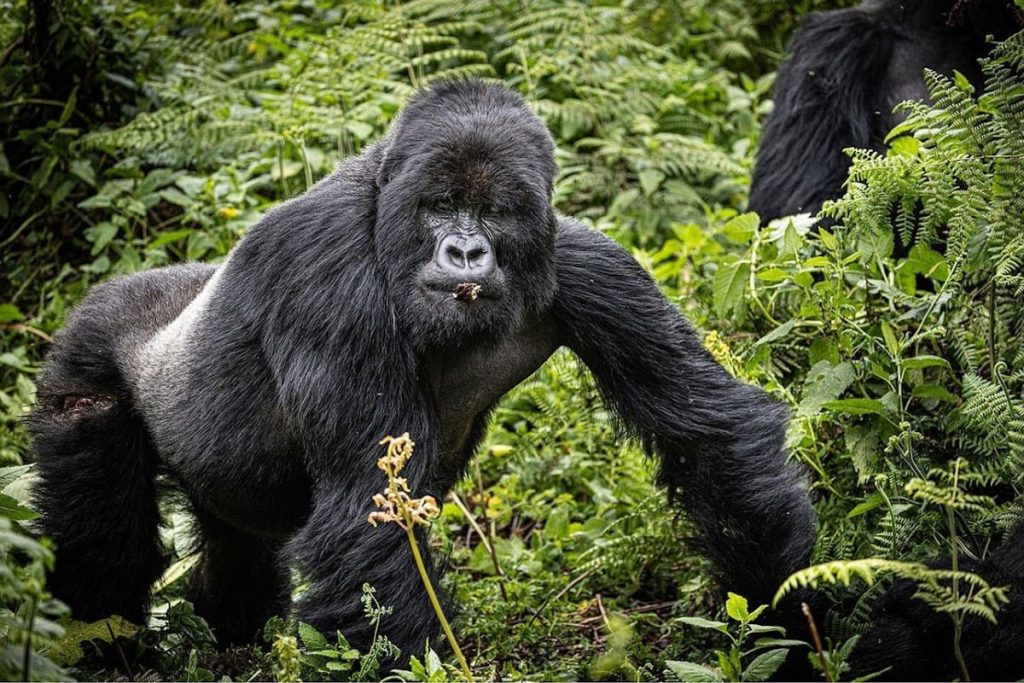
TLDR: Akagera and Volcanoes are completely different experiences, not competitors. Akagera is Rwanda’s savanna safari — Big Five game drives, Lake Ihema boat safaris, 490+ bird species, and the classic African wildlife experience. Volcanoes is mountain gorilla trekking in dense bamboo forest — a once-in-a-lifetime primate encounter with a $1,500 permit. Most visitors with 5+ days in Rwanda do both, and they should. If you only have time for one, this guide will help you choose.
The Quick Comparison
| Akagera National Park | Volcanoes National Park | |
|---|---|---|
| Experience type | Savanna safari (game drives, boat safari) | Mountain gorilla trekking |
| Key wildlife | Big Five, hippos, giraffes, 490+ birds | Mountain gorillas, golden monkeys |
| Landscape | Savanna, lakes, rolling hills | Volcanic mountains, bamboo forest |
| Distance from Kigali | 110 km east (~2.5 hours) | 116 km northwest (~2-3 hours) |
| Minimum time needed | 1 day (2 nights recommended) | 1 day (1-2 nights recommended) |
| Key cost | Park entry fees + accommodation | $1,500 gorilla permit + park fees |
| Best for | Wildlife enthusiasts, families, photographers, birders | Gorilla lovers, bucket-list travelers |
| Self-drive possible? | Yes | No (guided treks only) |
| Physical demand | Low (drive-based) | Moderate-high (hiking at altitude) |
What Akagera National Park Offers
Considering Akagera for your Rwanda itinerary? Mantis Akagera Game Lodge overlooks Lake Ihema inside the park — 9.1/10 from 413+ guests, game drives from the doorstep. Check availability on Booking.com
Affiliate link — helps support this site at no extra cost to you.
Akagera is Rwanda’s only savanna national park and the country’s only Big Five destination. Covering 1,122 square kilometers of rolling grassland, acacia woodland, lakes, and papyrus swamps, it delivers the classic East African safari experience that most people picture when they think of an African wildlife trip.
The wildlife: Lions (reintroduced in 2015 after 16 years of extinction), leopards, elephants, over 110 rhinos (including 70 white rhinos added in 2025), cape buffalo, hippos, giraffes, zebras, and more than 490 bird species. The conservation success story is remarkable — wildlife numbers have grown from under 5,000 to over 13,000 since African Parks took co-management in 2010. National Geographic named it a “Best of the World 2026” destination.
What you do: Morning and afternoon game drives in open 4×4 vehicles (or self-drive), boat safaris on Lake Ihema with hippos and crocodiles, night game drives for leopards and hyenas, hot air balloon rides, walking safaris, and world-class birdwatching. There is enough to fill 2-3 full days easily.
The pace: Akagera is relaxed and flexible. You set your own schedule (especially if self-driving), game drives are vehicle-based so physical fitness is not a factor, and you can mix activities throughout the day. It works for all ages, including families with young children.
What Volcanoes National Park Offers
Volcanoes National Park, in Rwanda’s far northwest, is one of only three places on Earth where you can see mountain gorillas in the wild. Approximately 1,000 mountain gorillas remain globally, split between the Virunga volcanic range (Rwanda, Uganda, DR Congo) and Uganda’s Bwindi Impenetrable Forest. The Rwandan sector in Volcanoes National Park is the most accessible and best-managed trekking experience.
The wildlife: Mountain gorillas are the star. There are about a dozen habituated gorilla families that can be visited by tourists. Each group is limited to 8 visitors per day, and you get exactly one hour with the gorillas once your guide locates them. Beyond gorillas, Volcanoes is also home to golden monkeys (a separate trekking permit, much cheaper), as well as forest elephants, bushbuck, and various bird species, though you rarely see these during treks.
What you do: The main activity is gorilla trekking. You hike through dense bamboo forest and volcanic terrain, sometimes for 1-2 hours, sometimes for 4-6 hours, depending on where the gorilla group is that day. The terrain is steep, muddy, and at altitude (2,500-3,500m). When you find the gorillas, you sit quietly and observe for 60 minutes. It is not an action-packed safari — it is a profound, quiet, emotional wildlife encounter.
The pace: Gorilla trekking is physically demanding. You need reasonable fitness, sturdy hiking boots, and tolerance for altitude. The trek can be anywhere from 1 to 7 hours of hiking, and the terrain is consistently challenging. If you have mobility issues, porters are available ($20-30) and some gorilla groups are assigned to closer locations for less mobile visitors, but this is not a walk in the park in any sense.
The Cost Comparison
This is where the difference becomes stark, and it is the single biggest factor in most visitors’ decision-making.
Akagera Costs
Park entry fees: Vary by nationality and are updated periodically — check visitakagera.org for current rates. Foreign adult entry fees are typically in the $40-100 range per day. Vehicle entry fees apply for self-drivers.
Activities: Boat safari on Lake Ihema is $40 per person (shared) or $180 for a private boat. Ranger-guide hire is about $40-50 per day. Night game drives are an additional fee. Guided game drives are included with some lodge packages.
Accommodation: Ranges from basic campsites ($30-50 per night) to mid-range tented camps ($150-300) to Mantis Akagera Game Lodge ($200-400+ per night depending on season). Budget options like Akagera Rhino Lodge sit at the lower end.
Total for 2 nights: Roughly $300-900 per person for a solid Akagera experience including park fees, activities, and mid-to-upper-range accommodation.
Volcanoes Costs
Gorilla trekking permit: $1,500 per person. This is non-negotiable and non-refundable (with limited exceptions for weather cancellations). It is the single most expensive line item in most Rwanda travel budgets. The permit includes park entry.
Golden monkey trekking: $100 per person — a much more affordable alternative if gorilla permits are sold out or outside your budget.
Accommodation: Lodges near Volcanoes range from budget guesthouses in Musanze ($50-100) to ultra-luxury options like Bisate Lodge or Singita Kwitonda ($1,500-3,000+ per night). Mid-range options run $150-400.
Total for 1-2 nights: $1,700-2,500+ per person minimum, with the gorilla permit being the largest cost. Luxury versions can easily exceed $5,000 per person.
Insider Tip: Gorilla permits sell out months in advance for peak season (June-September). If your dates are flexible, permits are often available with shorter notice during the wet season months (March-May, October-November). The experience is just as moving in the rain — and some argue more atmospheric. Book through the Rwanda Development Board (RDB) website directly, or through a licensed tour operator.
Who Should Choose Akagera?
Choose Akagera if you:
- Want a classic Big Five African safari experience with game drives and open savanna
- Are traveling with children or family members of mixed fitness levels
- Love birdwatching or wildlife photography (490+ species, open landscapes)
- Want flexibility and variety in activities (drives, boats, walks, night drives, balloon)
- Are on a tighter budget (an excellent safari without the $1,500 permit fee)
- Prefer a relaxed, vehicle-based experience rather than strenuous hiking
- Have already done gorilla trekking and want something different in Rwanda
- Want to self-drive and explore at your own pace
Who Should Choose Volcanoes?
Choose Volcanoes if you:
- Have gorilla trekking as a top bucket-list priority — this is genuinely one of the world’s great wildlife experiences
- Are physically fit enough for potentially 4-6 hours of steep hiking at altitude
- Have the budget for the $1,500 gorilla permit (plus accommodation and transport)
- Value a single profound wildlife encounter over a varied multi-day safari
- Are interested in primate behavior and conservation
- Want the bragging rights of seeing one of the rarest animals on Earth in the wild
Can You Do Both? (Yes, and You Should)
The honest answer is that Akagera and Volcanoes complement each other perfectly, and most visitors to Rwanda with a week or more should try to do both. They offer completely different ecosystems, different wildlife, different energy levels, and different emotional experiences. Together, they give you a complete picture of Rwanda’s extraordinary biodiversity.
The standard itinerary looks like this:
- Day 1: Arrive Kigali, explore the city (Kigali city guide)
- Day 2: Drive to Akagera (2.5 hours), afternoon game drive
- Day 3: Full day in Akagera — morning game drive, afternoon boat safari on Lake Ihema
- Day 4: Morning game drive, drive back to Kigali or directly northwest to Musanze (5-6 hours from Akagera to Volcanoes area, or break in Kigali overnight)
- Day 5: Gorilla trekking at Volcanoes (starts early morning)
- Day 6: Optional golden monkey trek or Dian Fossey hike, afternoon drive to Kigali
- Day 7: Depart
This 7-day itinerary covers both parks with enough time to do each justice. If you have fewer days, you can trim Akagera to one night (leaving from Kigali early and returning the next afternoon) and still fit in gorilla trekking.
Logistics: Akagera is east of Kigali, Volcanoes is northwest. You cannot drive directly between them without passing through Kigali (or taking a longer northern route). Most visitors transit through Kigali between the two parks. The drive from Kigali to the Volcanoes area (Musanze/Ruhengeri) is about 2-3 hours on a good road.
What About Nyungwe Forest?
Rwanda has a third major national park — Nyungwe Forest National Park in the southwest. If you are interested in chimpanzee trekking, canopy walks, and montane rainforest, Nyungwe adds yet another dimension to a Rwanda trip. A comprehensive 10-day Rwanda itinerary could cover all three parks plus Kigali.
“Best of three hotels visited during their Rwanda trip — the setting on Lake Ihema sets it apart.”
— Verified guest on Booking.com
Guests consistently rate Mantis Akagera Game Lodge as a highlight of multi-park Rwanda itineraries. With 9.6/10 for location and breakfast, it is the perfect base for your Akagera portion of the trip. See what 413+ guests are saying on Booking.com
Photo Gallery: Mantis Akagera Game Lodge

Start your Rwanda safari at Akagera
Mantis Akagera Game Lodge — 9.1/10 from 413+ guests. Big Five game drives, Lake Ihema boat safaris, breakfast rated 9.6/10, and the perfect first stop on a multi-park Rwanda itinerary.
Check prices and availability on Booking.com
Affiliate link — we may earn a small commission at no extra cost to you.
See Mantis Akagera Game Lodge for Yourself
Browse All Photos on Booking.com →
This post contains affiliate links. We may earn a commission at no extra cost to you.
Frequently Asked Questions
See Mantis Akagera Game Lodge for Yourself
Browse All Photos on Booking.com →
This post contains affiliate links. We may earn a commission at no extra cost to you.
Which is better, Akagera or Volcanoes National Park?
Neither is objectively “better” — they offer completely different experiences. Akagera is a savanna safari with Big Five game drives, boat safaris, and birdwatching. Volcanoes is mountain gorilla trekking in bamboo forest. Most visitors with 5+ days in Rwanda do both, as they complement each other perfectly.
How much does gorilla trekking cost at Volcanoes?
A gorilla trekking permit in Rwanda costs $1,500 per person. This is a flat fee set by the Rwanda Development Board (RDB) and includes park entry. The permit is required and non-refundable (with limited weather exceptions). Book 6-12 months ahead for dry-season dates. Golden monkey trekking at the same park is $100 per person.
Can you visit both Akagera and Volcanoes in one trip?
Absolutely, and most visitors with a week in Rwanda do exactly this. A typical itinerary spends 2 nights at Akagera, transits through Kigali, then 1-2 nights near Volcanoes for gorilla trekking. The two parks are on opposite sides of Kigali (Akagera is east, Volcanoes is northwest), with about 2.5-3 hours of driving from Kigali to either park.
Which park is easier with children?
Akagera is far more family-friendly. Game drives are vehicle-based (no hiking required), the lodge has kids’ club and playground facilities, and children of all ages can enjoy the boat safari and wildlife viewing. Gorilla trekking at Volcanoes has a minimum age of 15 and requires significant physical fitness for the hike.
How fit do you need to be for gorilla trekking?
Gorilla trekking involves hiking through steep, muddy terrain at 2,500-3,500m altitude for anywhere from 1 to 7 hours. You should be comfortable with sustained walking on uneven ground and moderate altitude. Porters are available ($20-30) to carry bags and provide support. Guides can assign less mobile visitors to closer gorilla groups, but some level of hiking fitness is unavoidable.
Is Akagera worth visiting if I am already doing gorilla trekking?
Definitely. The two experiences are completely different. Gorilla trekking is a single intense wildlife encounter in dense forest. Akagera is an open-savanna safari with diverse species across multiple days. Together, they give you the full spectrum of what Rwanda’s wildlife has to offer. Many visitors rate Akagera as an unexpected highlight precisely because they did not know Rwanda had a Big Five park.
How far apart are Akagera and Volcanoes?
The two parks are on opposite sides of Rwanda. Akagera is about 110 km east of Kigali (2.5 hours), while Volcanoes is about 116 km northwest of Kigali (2-3 hours). Driving directly between the parks takes 4-5 hours via Kigali. Most itineraries include a night in Kigali between the two parks rather than driving straight through.
When should I book gorilla permits?
For dry-season dates (June-September, January-February), book 6-12 months in advance through the Rwanda Development Board (RDB) or a licensed tour operator. Wet-season permits (March-May, October-November) are often available with shorter notice, sometimes just a few weeks ahead. Permits sell out for popular dates, so do not wait if your travel dates are fixed.

